

SONGPROOF
Legal Validity & Evidentiary Value
A Reference Document for Artists, Attorneys & Industry Professionals
Prepared by SongProof | songproof.com | 2026
This document is provided for educational purposes only and does not constitute legal advice. For specific copyright matters, consult a qualified attorney
Download Paper from here:
What Is SongProof?
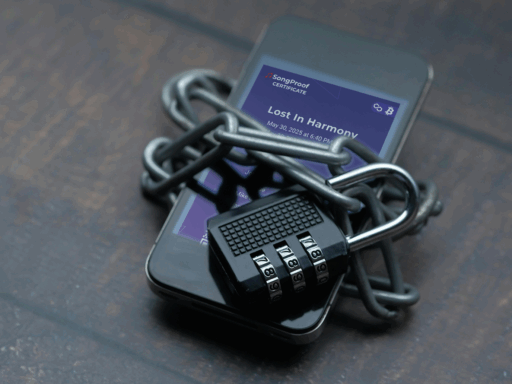
SongProof is a blockchain-based platform that creates an independent, immutable, timestamped record of a musical work at the exact moment of its creation. For as low as $0.99 per song, it gives artists instant, affordable proof of authorship — before they register with a copyright office, before they sign a deal, and before anything can go wrong.
SongProof does not replace formal copyright registration. It is the critical step that comes before it — securing the moment of creation in a way that no platform, no collaborator, and no infringer can later dispute.
| The Core Question in Every Copyright Dispute: “Who can prove they created this work first?” — SongProof answers that question the moment you press record. |
1. Understanding Copyright & The Role of Timing
Why Timing Is Everything
One point that often gets overlooked in copyright disputes is the role of timing. Even before a formal registration has been completed, establishing clear evidence of when a work was created can be extremely valuable.
In practice, disputes almost always come down to one question: who can demonstrate they created the work first? A reliable, timestamped record strengthens that position significantly. It provides a clear reference point that can support legal arguments, guide negotiations, and in many cases help resolve conflicts before they escalate to full litigation.
For example: if an artist creates a song and secures a SongProof timestamp at that moment, they have an independent, verifiable record of authorship and timing. If someone else later takes that work, registers it, or attempts to claim ownership, the existence of an earlier timestamp becomes a critical piece of evidence.
Formal Registration vs. Proof of Creation
These are two different — and complementary — things:
| What It Does | |
| Copyright Registration | Formal legal protection. Required in the US to unlock statutory damages and file a lawsuit. Jurisdiction-based. |
| SongProof Timestamp | Independent, global proof of creation. Establishes authorship and timing instantly. Works alongside registration. |
So while formal copyright registration remains essential for full legal protection, establishing proof of creation early plays a meaningful role — especially in fast-moving, collaborative environments where works are shared before registration is complete.
2. Statutory Damages: A Global Perspective
The US Advantage
Most people don’t realize how rare and powerful the US copyright system actually is. Out of roughly 177 countries, only about 24 allow statutory damages for copyright infringement. In most of the world — including major creative economies like the UK, France, Germany, Australia, and much of Latin America — a creator who gets ripped off must prove actual financial losses in court, which is notoriously difficult and expensive.
The US is one of the few exceptions. Under 17 U.S.C. § 504, a registered copyright holder can claim between $750 and $30,000 per infringed work without proving a dollar of actual loss — and up to $150,000 per work if the infringement was willful.
| Why This Matters for SongProof Users Statutory damages are only available to copyright holders who registered their work before infringement began — or within three months of publication. |
How Key Jurisdictions Compare
| Country / Region | Statutory Damages Position |
| United States | $750–$30,000 per work (standard); up to $150,000 for willful infringement. Registration required before infringement. |
| Canada | $500–$20,000 per work (commercial); $100–$5,000 total (non-commercial). No registration required to claim. |
| UK / Germany / France / Australia | No statutory damages. Courts require proof of actual financial loss. |
| Mexico | Minimum floor of 40% of the infringing product’s retail price. No fixed statutory damages in the US sense. |
| Brazil / Argentina / Colombia | No statutory minimum damages. Actual loss must be proven. Proof of authorship is therefore even more critical. |
| Costa Rica / Dominican Republic | Statutory damages exist, largely introduced through US free trade agreements. |
This global picture explains why SongProof’s value proposition shifts by market. In the US and Canada, the timestamp strengthens the evidentiary foundation that unlocks statutory damages. In most of Europe and Latin America, where actual loss must be proven, the timestamp becomes the primary tool for establishing ownership in the first place.
Whether the dispute arises in Nashville, Toronto, London, or São Paulo, the question is the same: Can you prove you created this first?
3. Legal Recognition of Blockchain Evidence
Courts Are Already There
SongProof is not asking courts to accept something untested. Legislatures and courts in North America and Europe have already begun formally recognizing blockchain-preserved records as admissible evidence.
Just as courts once had to grapple with whether email threads or text messages could constitute evidence — and ultimately ruled that they could — the same evolution is now happening with blockchain timestamps. And importantly, courts are not treating blockchain evidence as something exotic. They are evaluating it using the same frameworks applied to any digital record: authenticity, source, and reliability.
North America: Legislative Recognition
In the United States, multiple states have passed legislation explicitly recognizing blockchain records as admissible evidence in legal proceedings:
- Vermont (2016): Enacted legislation under which blockchain records are presumed authentic and self-authenticating under Vermont Rules of Evidence — the first state to do so.
- Illinois (2020): The Blockchain Technology Act explicitly deems records generated via blockchain admissible as evidence in legal proceedings.
- Arizona, Ohio, Delaware: All enacted legislation recognizing blockchain records and signatures as valid legal instruments.
At the federal level, US courts apply established evidentiary frameworks — including authentication standards under FRE 901 and the business records exception under FRE 803(6) — to blockchain records, the same way they apply them to other digital evidence such as cell phone records, IP logs, and financial data.
Europe: Judicial Recognition
The landmark European ruling came on March 20, 2025, when the Tribunal Judiciaire de Marseille — a French civil court — ruled in favor of fashion house AZ Factory in a copyright infringement case against wholesaler Valeria Moda.
AZ Factory had anchored the digital fingerprints (hashes) of its original designs onto the Bitcoin blockchain in 2021. When infringement occurred, those timestamps became central evidence. The court fully accepted the blockchain timestamp reports as valid proof of ownership — ruling that the date recorded on the blockchain was the date that mattered.
| Tribunal Judiciaire de Marseille — March 20, 2025 (RG No. 23/00046) The court held that a timestamp recorded on a public blockchain constitutes admissible evidence to establish ownership of copyright — the first such decision in French law, and the first in Europe. It was described as sending a strong signal in favour of recognizing blockchain technology as a legitimate evidentiary tool in intellectual property disputes. |
The European Union Intellectual Property Office (EUIPO) subsequently documented this ruling as significant precedent for how blockchain timestamps establish authorship across EU jurisdictions.
Importantly, the court noted that blockchain evidence does not stand alone — it forms part of a broader body of evidence alongside other records. This is exactly how SongProof positions its certificates: not as a magic bullet, but as a strong, independent anchor for the creator’s timeline.
Latin America: An Emerging Landscape
No Latin American court has yet issued a verified, citable ruling specifically validating blockchain timestamps as copyright evidence. We are being transparent about this because accuracy matters more than a compelling story.
That said, the direction is clear. Brazilian copyright law already allows alternative proof of authorship beyond formal registration, and several countries in the region are actively developing digital evidence frameworks. For creators in Latin American markets, a SongProof timestamp provides exactly the kind of documented, dated proof of creation that courts already evaluate when formal registration is absent.
4. Where SongProof Fits in the Legal Workflow
The Gap SongProof Fills
Copyright is still jurisdiction-based. It provides strong legal recourse where it’s registered — but in today’s reality, where music spreads instantly across Spotify, YouTube, TikTok, and Instagram, infringement often happens across borders where enforcement becomes complex, delayed, or impractical.
SongProof addresses that gap. It creates a universal, timestamped record of creation at the exact moment the work exists — something that travels with the music globally, regardless of platform or geography.
| Stage | SongProof’s Role |
| Creation / Demo phase | Timestamp the work the moment it exists. Establishes priority before anyone else has access. |
| Studio / Collaboration | Provides independent record outside of any studio’s systems, DAW metadata, or email chains. |
| Pre-release / Pitching | Demonstrates authorship before formal registration is complete. |
| Post-registration | Corroborates the registration with an earlier, independent timestamp on a public blockchain. |
| Dispute / Litigation | Provides attorney with a court-ready record of creation date and authorship. |
| Cross-border infringement | Provides a globally verifiable record that is not tied to any single jurisdiction. |
For Attorneys
An attorney representing a copyright holder needs to establish two things above all else: ownership and timing. SongProof’s blockchain timestamp provides an immutable, independently verifiable record of both — created at the moment the work was made, not after a dispute arose.
This strengthens the evidentiary foundation that unlocks statutory damages in the US, supports registration-based claims in Canada, and provides credible proof of authorship in jurisdictions where actual damages must be proven. It doesn’t replace the attorney’s work — it makes that work easier to do.
5. The Direction of Travel
Just as communication itself has evolved — from formal letters to email to instant messaging on WhatsApp, Slack, or DMs — the way creators establish proof of ownership must evolve too. The platform you use to share your work should never determine the strength of your legal position.
SongProof provides independent, platform-agnostic proof of creation that exists entirely outside of any messaging app, social network, or streaming service. It doesn’t matter if the work was shared via email, a voice note, a Google Drive link, or a DM — the SongProof timestamp lives on the blockchain, independently of all of them.
Are we early? Perhaps. The legal frameworks are still catching up, and courts are only beginning to grapple with blockchain-based evidence at scale. But the direction is clear. Vermont recognized it in 2016. Illinois followed. France just issued its first landmark ruling in 2025. The trajectory is unmistakable.
| In matters of intellectual property, being early is far better than being unprepared. SongProof gives creators the tools to protect themselves today — in a legal landscape that is actively moving in their direction. |
Summary: The SongProof Position
| What SongProof Is | What SongProof Is Not |
| An independent, blockchain-based timestamp of creation | A substitute for formal copyright registration |
| A global, platform-agnostic proof of authorship | Jurisdiction-specific legal protection |
| A tool that strengthens an attorney’s evidentiary position | Legal advice or a guarantee of outcome |
| Legally recognized evidence in the US (multiple states) and Europe (France, 2025) | Accepted in every jurisdiction without question |
| The first step in protecting a creator’s rights | The last step — registration and legal counsel remain essential |
SongProof — First Step. Global Proof.
songproof.com | For as low as $0.99 per song